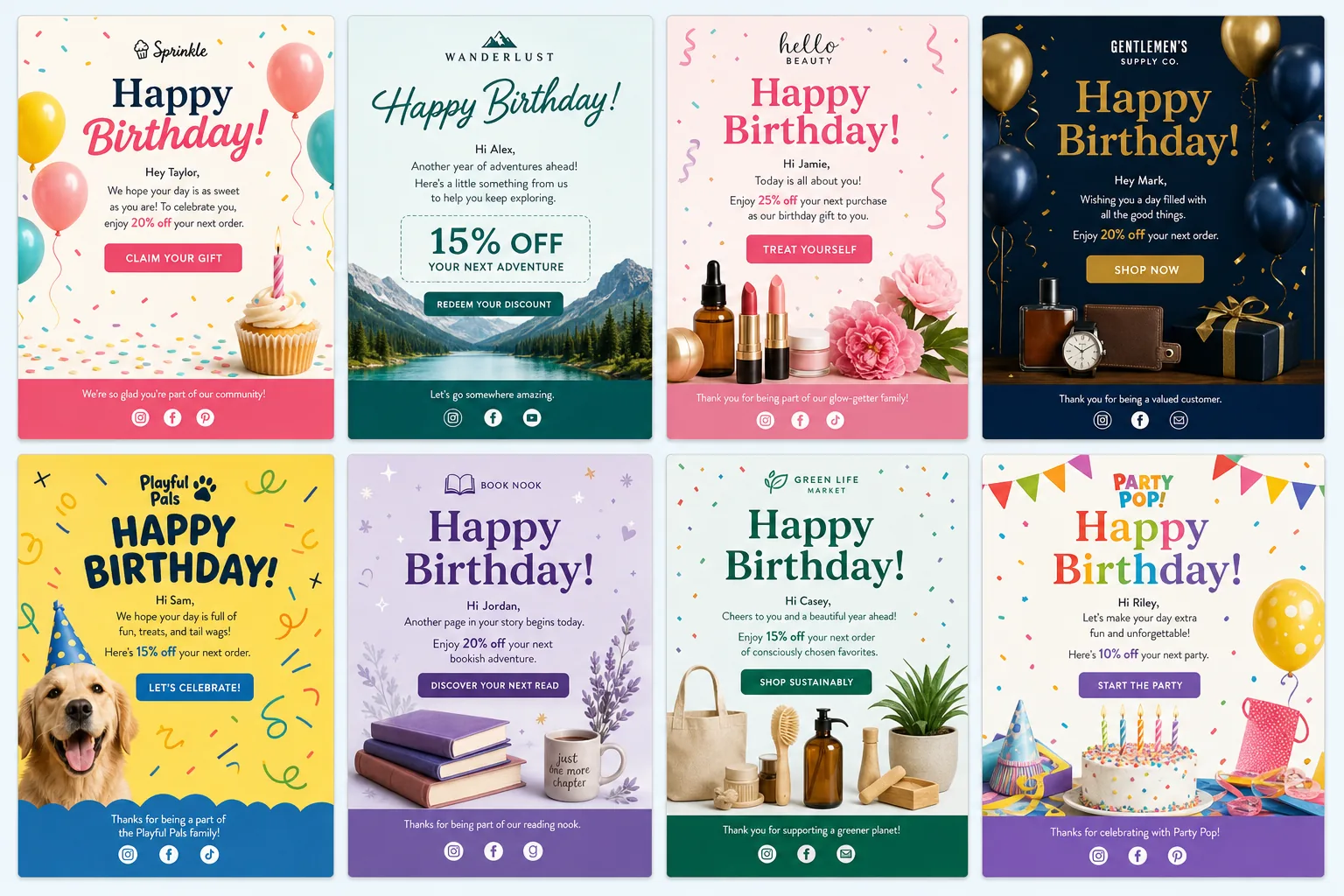
Birthday emails are one of the easiest lifecycle moments to overlook and one of the most useful to systematize. The customer has already shared a personal date, the message has a natural reason to exist, and the offer can feel like a reward instead of a generic promotion. For CRM and lifecycle teams, strong birthday email examples are not just cute creative references. They are blueprints for an automated flow that can support retention, loyalty, repeat purchase, and brand affinity with relatively low operational effort.
The best birthday campaigns usually have three things in common: a clear offer, a simple reason to act, and creative that feels personal without becoming complicated. The email does not need to carry a long story. It needs to make the recipient feel recognized, explain the birthday benefit, and remove friction from the next click.
See also: email marketing campaign ideas
Below are 10 practical birthday email examples organized by offer strategy first. Use them to decide what kind of birthday reward fits your brand, then refine the subject line, design, timing, and measurement plan around that decision.
Why birthday emails deserve a dedicated lifecycle flow
A birthday email should not be treated like a one-off promotional blast with balloons added. It deserves a dedicated lifecycle flow because the message is triggered by customer data, arrives in a predictable personal moment, and can be tailored by lifecycle stage, loyalty tier, purchase history, or engagement level.
For email marketers, the main advantage is relevance. A birthday message has built-in context. The recipient understands why they are receiving it, which can make the offer feel less intrusive than a standard sale announcement. For designers, the challenge is to make the celebration obvious while keeping the offer and call to action easy to understand on mobile. For CRM teams, the opportunity is to create a reliable automated touchpoint that can be measured, tested, and improved over time.
A strong birthday email flow usually includes:
- A clear primary offer: The recipient should understand the reward within seconds.
- A visible expiration window: The deadline should motivate action without creating unnecessary pressure.
- Personalization where it helps: First name, loyalty tier, preferred category, or nearby store details can add relevance when the data is reliable.
- Mobile-first creative: The reward, code, and CTA should remain readable in a narrow viewport.
- Fallback logic: If the birthday date is incomplete or the customer is ineligible for an offer, the automation should not break or send an awkward message.
The following birthday email examples are designed as strategic patterns, not templates to copy word for word. The right version depends on your margins, product category, purchase frequency, and customer expectations.
10 birthday email examples with great offers, grouped by promotion type
1. Percentage discount birthday offer
Example offer: “Happy birthday. Enjoy 20% off your next order this month.”
A percentage discount is one of the most familiar birthday offer types because it is easy to understand and easy to apply across a catalog. It works especially well for apparel, beauty, home goods, accessories, and other categories where customers may browse multiple products before choosing.
Why it works: The offer feels flexible. Instead of pushing a single item, it lets the customer choose their own gift. That makes it useful when your customer base has diverse preferences or when your product range is broad.
How to adapt it: Use a higher percentage for loyalty members, a lower percentage for first-time buyers, or category-specific exclusions if margin protection is important. Keep the code simple and place it near the CTA so the recipient does not need to search for it.
2. Dollar-off birthday reward
Example offer: “Here’s $15 toward your birthday treat.”
A fixed-value reward can feel more tangible than a percentage discount. For many recipients, “$15 off” is easier to evaluate than “15% off,” especially when average order values are moderate and the savings are immediately clear.
Why it works: Dollar-off offers feel like stored value. They can read as a birthday credit rather than a discount, which often feels more personal and gift-like.
How to adapt it: Set a minimum spend carefully. “$15 off $75” may protect margin, but “$15 birthday credit” sounds more generous. If a minimum is necessary, make it visible before the click so customers do not feel surprised at checkout.
3. Free gift with purchase
Example offer: “Choose a free birthday gift with your next order.”
A free gift with purchase is a useful birthday email example for brands that want to protect discount perception. Instead of lowering the price of the main product, the campaign adds a special item that feels celebratory.
Why it works: The customer gets something extra. That aligns naturally with the birthday moment and can introduce trial of a new product, seasonal item, sample, or accessory.
How to adapt it: Let customers choose from two or three gift options if inventory allows. Choice increases perceived relevance without requiring complex personalization. If the gift is predetermined, show it clearly and explain the value.
4. Completely free birthday item
Example offer: “Your birthday drink is on us.”
This format is common for food, beverage, wellness, and local retail brands, but it can also work for digital products, samples, add-ons, or low-cost accessories. The offer is simple: no discount math, no complicated bundle, just a gift.
Why it works: A free item creates a strong sense of goodwill. It can drive store visits, app engagement, or account logins even when the recipient was not already planning to buy.
How to adapt it: Make redemption instructions extremely clear. If the customer must show an email, open an app, log in, or visit a store, the email should explain that process in plain language.
5. Free shipping birthday perk
Example offer: “Birthday perk unlocked: free shipping on your next order.”
Free shipping is a practical birthday offer for ecommerce teams that want to reduce purchase friction without running a deeper product discount. It is especially useful when shipping cost is a common barrier to conversion.
Why it works: It removes a known checkout objection. The offer may not feel as exciting as a free product, but it can be effective for customers who already have purchase intent.
How to adapt it: Pair free shipping with curated birthday picks, back-in-stock products, or previously browsed categories. If free shipping alone feels too light, combine it with early access or a small sample.
6. Bonus loyalty points
Example offer: “Celebrate with 500 bonus points in your account.”
Bonus points are a strong fit for brands with established loyalty programs. They reinforce program value and encourage customers to return to their account rather than simply redeeming a one-time coupon.
Why it works: Points can create a sense of progress. If the customer is close to a reward threshold, the birthday bonus may motivate another purchase or login.
How to adapt it: Show the customer’s current point balance if your data is reliable. If not, use a simpler message: “We added 500 birthday points. Log in to see your balance.” Avoid making the email dependent on dynamic content that may fail or display incorrectly.
7. Tiered birthday reward for loyalty members
Example offer: “Gold members get a $25 birthday reward this month.”
For more context, according to McKinsey offers additional background on this topic.
A tiered birthday reward gives your loyalty program a visible benefit. Instead of sending the same offer to every subscriber, the birthday email reinforces the value of being in a higher-status segment.
See also: christmas email template
Why it works: It makes loyalty status feel meaningful. The reward becomes part of the membership experience, not just another campaign.
How to adapt it: Create simple tiers such as standard, VIP, and top-tier members. The difference can be reward value, redemption window, gift choice, or access to exclusive products. Keep the logic manageable so the campaign remains easy to QA.
8. Birthday upgrade offer
Example offer: “Enjoy a complimentary upgrade for your birthday.”
Upgrade offers work well for subscriptions, travel, hospitality, software, services, memberships, and premium experiences. Instead of reducing the price, the campaign lets the customer experience a higher level of value.
Why it works: It creates a trial moment. Customers can experience premium features, elevated service, faster delivery, a larger size, or a better package in a context that feels like a gift.
How to adapt it: Define the upgrade clearly. “Upgrade” is vague unless the email states what changes: premium plan for 30 days, deluxe room when available, larger size, priority support, or enhanced service package.
9. Exclusive birthday access
Example offer: “Birthday access: shop the new collection before everyone else.”
Not every birthday offer has to be a discount. Exclusive access can be effective for brands with limited drops, seasonal collections, waitlists, communities, or content-based products.
Why it works: It taps into status and recognition. The customer feels invited rather than sold to, which can be valuable for premium brands that avoid frequent discounting.
How to adapt it: Make the exclusivity concrete. Early access should have a real window, such as 24 or 48 hours. If access is not truly limited, the message can feel hollow.
10. Limited-time birthday bundle
Example offer: “Build your birthday bundle and save.”
A birthday bundle can increase average order value while still giving the customer a celebratory reason to buy. It works well when products are naturally complementary, such as skincare routines, stationery sets, coffee assortments, home essentials, or hobby kits.
Why it works: Bundles make choice easier. Instead of asking the customer to browse the entire catalog, the email presents a curated path.
How to adapt it: Offer two or three bundle options by use case, price point, or customer type. Keep the CTA focused: “Build your bundle,” “Choose your set,” or “Claim your birthday bundle.”
How to choose the right birthday offer
The best offer is not always the richest offer. It is the one that matches customer motivation, product economics, and the role of the birthday email in your lifecycle program. A high-margin ecommerce brand may comfortably test a percentage discount. A premium brand may prefer exclusive access. A loyalty-led brand may get more long-term value from points than from a one-time coupon.
Use these decision criteria before choosing from the birthday email examples above:
- Product category: Consumables and food brands can often use free items effectively. Apparel and home brands may benefit from percentage discounts. Subscription and service brands may be better suited to upgrades or trial extensions.
- Margin structure: If margins are tight, consider free shipping, points, access, samples, or gifts with purchase instead of broad discounts.
- Purchase frequency: If customers buy often, a short redemption window may be enough. If purchases are considered or seasonal, give the birthday reward more time.
- Brand positioning: Premium brands may want to avoid language that feels like clearance promotion. Use “birthday reward,” “gift,” “credit,” or “private access” instead of aggressive sale language.
- Lifecycle stage: New subscribers may need a stronger incentive to make a first purchase. Existing customers may respond well to loyalty points, upgrades, or category recommendations based on past behavior.
There is also a psychological difference between discounts and gifts. Discounts reduce the price of a transaction; gifts can create a stronger sense of reciprocity and recognition. This is a useful place to later add an authoritative citation on promotional psychology, customer loyalty, or email marketing best practices.
Practical rule: if the birthday email is meant to drive immediate revenue, start with a clear monetary offer. If it is meant to deepen loyalty, consider a gift, points, access, or upgrade that feels more personal than promotional.
Subject line patterns that make birthday emails stand out
The subject line should make the birthday context and offer obvious without sounding like every other automated email in the inbox. The goal is not to be clever at the expense of clarity. A good birthday subject line tells the recipient why the message matters now.
Useful patterns include:
- Name plus celebration: “Maya, your birthday surprise is here”
- Offer-led: “Your $15 birthday reward is waiting”
- Deadline-led: “Last week to use your birthday gift”
- Loyalty-led: “A birthday perk for our Gold members”
- Simple and warm: “Happy birthday from us to you”
- Curiosity with clarity: “We saved a birthday treat for you”
Preview text should complete the inbox package. If the subject line says “Your birthday surprise is here,” the preview text can clarify: “Enjoy 20% off your next order through the end of the month.” If the subject line already includes the offer, the preview text can explain timing or redemption: “Use your reward online or in store before May 31.”
Avoid subject lines that overuse punctuation, all caps, or vague urgency. “HURRY!!! Birthday deal inside” may attract attention, but it can weaken brand trust. The best birthday email subject lines feel celebratory and direct: personal enough to be relevant, clear enough to be understood at a glance.
Design and accessibility tips for birthday email creatives
Birthday email design can be playful, but the offer still needs to be functional. Designers should build around a clear visual hierarchy: celebration first, offer second, CTA third, supporting details fourth. If the recipient has to scroll past a large image before understanding the reward, the creative is working against the campaign goal.
For responsive HTML email teams, focus on these execution details:
- Make the offer readable without zooming: Use large text for the reward and avoid placing essential details only inside an image.
- Use one primary CTA: “Claim your birthday reward” is usually stronger than multiple competing buttons.
- Keep the code visible: If a promo code is required, place it near the CTA and repeat it in the supporting copy if needed.
- Design for thumb taps: Buttons should be large enough to tap comfortably on mobile, with enough spacing from surrounding elements.
- Balance festive visuals with brand consistency: Balloons, confetti, cake, candles, and gift shapes can work, but they should not make the email feel disconnected from the brand.
- Plan for dark mode: Check whether key colors, logos, and CTA styles remain legible when clients invert or adjust colors.
Accessibility should be part of the creative brief, not a final QA note. Use strong color contrast for text and buttons. Keep live text for the main offer whenever possible. Write alt text that communicates the purpose of an image, not just the decoration. For example, “Birthday gift box illustration” is fine for a decorative image, but “Enjoy $15 off your birthday order” should be live text, not trapped in an image with missing alt text.
Also consider fallback content. If dynamic personalization fails, the email should still read naturally. “Happy birthday!” is safer than “Happy birthday, FIRSTNAME!” if your merge tag process is not fully reliable. For complex loyalty or points modules, define what appears when the balance is unavailable.
Implementation checklist: timing, segmentation, and measurement
A birthday email campaign is only as strong as its operational setup. Before launching, map the data source, eligibility rules, send timing, offer logic, and reporting framework. The more automated the flow, the more important the checklist becomes.
Use this practical checklist for deployment:
- Confirm the birthday data field: Decide whether you need month and day only, or full date of birth. Collect only what you need.
- Set the send window: Common options include the first day of the birthday month, one week before the birthday, the birthday itself, and a final reminder before expiration.
- Define expiration logic: Use a clear redemption period, such as 14 days, birthday month, or 30 days from send.
- Segment by customer status: New subscriber, first-time buyer, repeat customer, loyalty member, lapsed customer, and VIP segments may warrant different offers.
- Suppress where needed: Avoid overlapping with sensitive journeys, recent service issues, unsubscribed contacts, or customers in regions where the promotion is not valid.
- QA every version: Test merge tags, coupon codes, loyalty modules, expiration dates, mobile rendering, dark mode, and fallback content.
- Measure beyond opens: Track click-through rate, redemption rate, revenue, average order value, repeat purchase, loyalty engagement, and unsubscribe rate.
- Test one variable at a time: Start with offer type, then test timing, subject line, creative layout, CTA language, or reminder cadence.
For many teams, the best starting flow is simple: one birthday email at the beginning of the birthday month and one reminder before the reward expires. Once that baseline is stable, add segmentation and testing. A VIP customer might receive a richer reward. A lapsed customer might receive a stronger incentive. A highly engaged customer might only need exclusive access or bonus points.
Use these birthday email examples as a blueprint for building a clearer, more effective birthday flow in your CRM program. Start with the offer, then tighten the subject line, design, accessibility, timing, and measurement plan. When each part supports the same goal, the birthday email becomes more than a polite greeting. It becomes a dependable lifecycle touchpoint that feels personal, on-brand, and easy to act on.
See also: outlook html email template
Leave a Reply